

Perfect Days
The spring I became a working girl

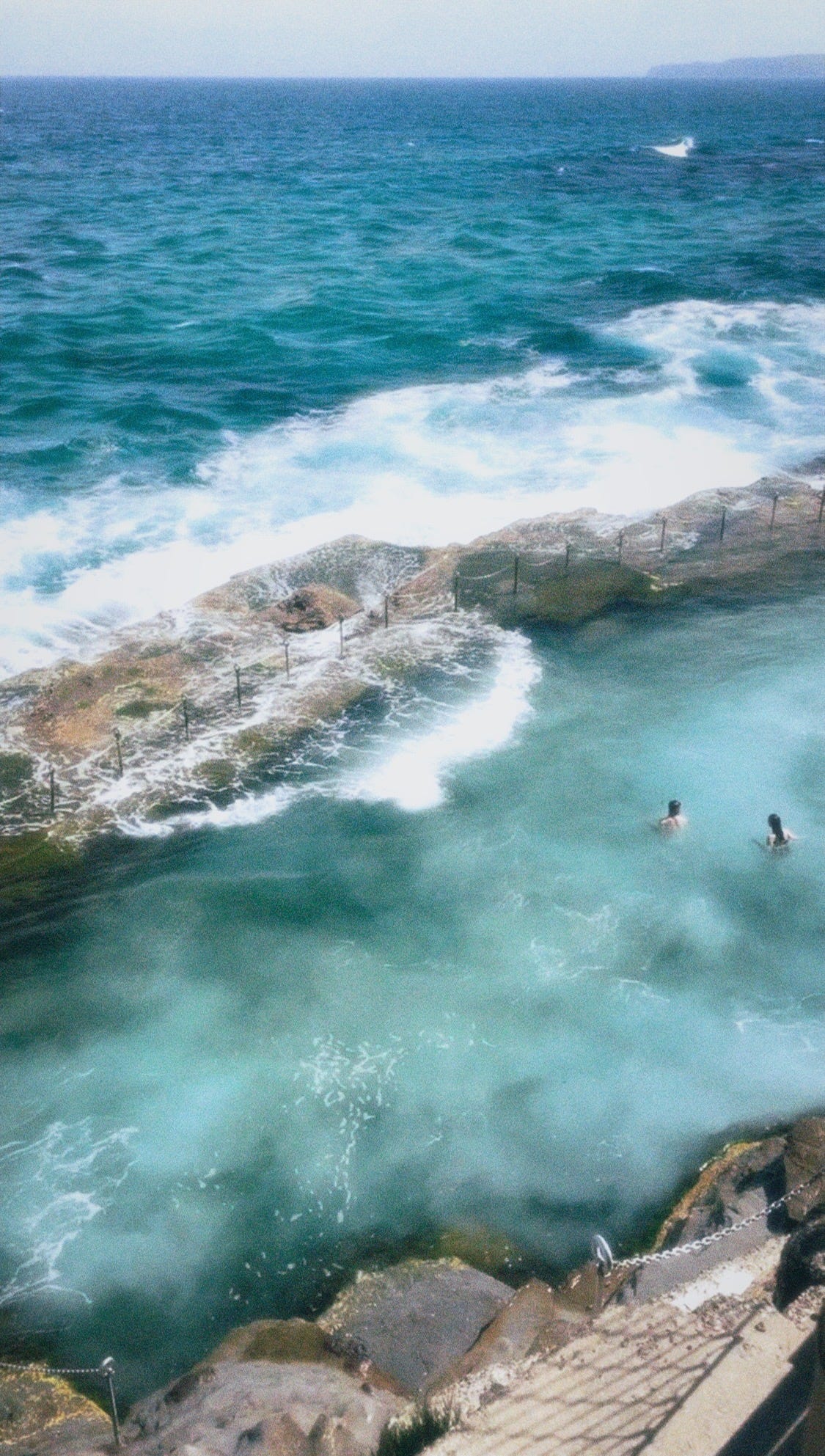
I began writing this entry last week from Lake Macquarie, New South Wales, in a three-bedroom Airbnb with a backyard that was bigger than the townhouse we rent and a driveway that had a slice-view of Sugar Bay. I was spending a few days there with my family to celebrate my sister’s birthday and suddenly felt clear enough in my head to write. But whatever inspiration I’d found lying in bed was immediately interrupted as I woke the next morning feeling sick and spent the rest of that holiday mending myself.
Even so, the days in the east coast were stark bright, the ocean foamy and large and completely marvellous. In Sydney I kept telling my friend K. who we visited that the place had no resemblance with Melbourne at all, that the scenery was gorgeous, and it was all very nice. Maybe too nice. In certain moments I began to wonder why I didn’t live near the coast, and then almost instantaneously I was reminded of my home, meaning Melbourne, my home, its erratic weather, its diverse choices of restaurants, the stranger on the tram who would compliment my shoes, the surprise of summer, the noise, the stillness at dawn, my good friends, the people I love, that place I’ve fought for for nearly a decade, and I understood, just as quickly as I tended to forget, why my heart completely belonged to that city and nowhere else.
The east coast was lovely, though – I have to give credit where credit is due. The downside to loveliness, to happiness, to peace, was that my thoughts didn’t come because there was no need to untangle or dissect or make meaning of anything. I was empty in the best sense of the word. I was empty and yearning to spear my boat and bore a hole in its wood to fill it with water. Make it sink. Just destroy it enough to have something to get my hands on, to try to put it back together, to fill my head, my time.
Technically speaking, my time is filled. I complain to my friends: I really have no time anymore. I message prospective dates and make excuses for my slow responses: This is just a really busy period of life and work. A couple of weeks ago I emailed my editor: I need more time. And so she’s given me more time—a whole month of extension, in fact—as if time was something to give, not already given, as if it wouldn’t pass no matter.
My sense of time has been turned upside-down, if I could call it that, ever since I started my new job. I have become a morning person waking up at six, sometimes earlier, pulling the blinds open and feeling moved by the soft light just beyond the roofs of houses. Before seven, I am out the door with my KeepCup in hand, bright and chirpy at my local café where I exchange pleasantries with the owner Jack, or ask the Vietnamese barista, Irene, how she is doing and in turn she checks on how bad my hay fever is on a given day. I ride the tram and then take the bus to the city and, in the office building, let the elevator take me up the floors as I draw my gaze at the length of Royal Parade, the high buildings, up and up, a sliver of the mountains (I still don’t know which one) until I sit at my desk and work begins. Many days I feel lucky to have found a job and many days I wonder how I got here, both useful and useless, numb and high-wired, stable and frazzled. I leave work at four p.m. if it’s a slow day, and I am in bed, about to doze off, before ten. Who have I become?
I am amused by this novelty that I announce it to everyone: my colleagues, my friends, my family. Nine-to-five (eight-to-four, rather) has cured my insomnia, I tell them. I found the answer to sleeping at five in the morning, I say. Get a job! There is a passage in my manuscript where the unemployed narrator reflects on the absurdity of watching humans traveling to work. The swath of people waiting for public transport, their similar attires, the same sunken look on their faces. But at the same time she hopes to be part of this group: give me a job, too! The trade-off for money is the soul. An unhelpful statement, I know. Some of my friends enjoy their work, are doing excellent things, are contributing to the betterment of society, etc. But I also know they—we—will enjoy doing it less.
I did pray for this. When I arrived for the nth time in Melbourne back in August, I did pray for a job. I did hope for the gods to extend their blessings to a stable income. I hoped not to do more job interviews than I’d already done. I hoped not to despair, not to return to daycare centres, not to have four jobs at once. Just one, I prayed, one is surely easier to grant than four. Just one.
And so here it is. The one. And I do my bit every day and in the six and a half weeks I have been in the job I have been praised a few times for doing well what I am paid to do well. And to avoid sounding like an ungrateful employee, I should say it is a good job, the best job I’ve had truly if these things are measured by compensation, genuinely caring colleagues, an allowance for off-the-cuff chats and laughs, the willingness to lose ourselves on the dance floor at the end-of-year party, and the occasional use of boardroom for an hour-long breakfast yarning about non-essential things.
It is too good, really, because it prevents me from thinking about my melancholy—what melancholy?—and my sadness and my uncertainties and my longings and my novel and my hope to make more art. It has prevented me from thinking. Full stop.
And there lies the problem because, god, do I love thinking.
In Perfect Days (dir. Wim Wenders, 2023) the viewers follow the protagonist Hirayama (Kōji Yakusho), a toilet cleaner in Tokyo, as he goes about his daily life. He wakes up early, waters his tiny pots of plants, drives his van to work, listens to an incredible rotation of cassette tapes, and spends his day cleaning toilets with such care for detail. The first time he pauses and looks up to the sky to observe and relish it, and smiles, the stream of tears fell from my eyes. How poignant those moments are, those seconds we borrow from our lives to marvel at the world.
Although Hirayama’s job is not glamorous, the film depicts his life as almost idyllic. What else could one ask for when you have a book to read at night, a home enough for all your needs, art in whichever form, meals at the end of the day? And yet isolation is central too. Pervasive. Of course it cannot be too perfect. It might be lonely. But it looks like a satisfying way to live and die.
Could I organise my life as such? Is there a world where I could put my head down with any job, regardless of title or pay or its demands of me, set myself up with only what I deem necessary, which is art, always art, and call it my life? I think the beauty and misfortune of what Hirayama has is that he does not surround himself with anyone. There are people who come and go—the chaotic, younger co-worker, his girlfriend who shares Hirayama’s love for music, the restaurant owner who sings a beautiful ballad, her ex-husband, and his niece and sister. Through his solitude, Hirayama is allowed to live by his standards. I imagine that if any of these people stay in his life or come close enough to him, closer than he lets them, then something might flip. Something might press up against him that he begins to doubt. Or not. Maybe that is my projection, my own discomfort at having had to witness someone so comfortable with their own path, so content in living so simply without any need for material luxuries, without the hanging cloud of unstable housing or retirement or the question of supporting a spouse or children or pets or loved ones through sickness and death.
In the cinema I cried endlessly, wiping the corner of my eyes. I didn’t know what for or why, but I think I was watching a dream I have had once and also knew that if that were to come true, like Hirayama, loneliness would await me, accompany me. The viewer does not see him having to make a choice; the choice has been made when we meet him. It is the living of that life that we journey through. It is the consequences—deep beauty, deep feelings, deep solitude, deep pain—that we witness. A life of one, touched by many.
Robert Grainier (Joel Edgerton) in Train Dreams (dir. Clint Bentley, 2025) is also a loner. A logger in the Pacific Northwest who keeps to himself, barely speaks, and thinks deeply, meets the love of his life and begins a life with her in a small cabin. What he knows are the trees, the cut of the axe, hard labour, and so he goes away for months leaving his small family behind. That is his anchor, the reason he always returns. A loner who is in love. Why does that make me think he is therefore not alone? But of course because he is in love and not alone the risks of his job become higher. (What are the risks of Hirayama’s life? What has he got to lose? The cassette tapes. His space. His solitude. Different. Same.)
At the turn of the twentieth century, Robert encounters the new world. New machines. People who care less about the land. People who are evil have been there since he was young but there is something about nonchalance that is particularly sinister. When someone has stopped caring, then where do morals lie? And values? How does one navigate the world? In the later part of the film, a fatal loss strikes Robert and it seems like the ultimate payback for his logging years. Mother Nature has taken action. Despite Robert’s good-heartedness and good intentions. That is usually the case, isn’t it? Intentions could only go far. More often than not, we fail ideologically. There are always consequences to our choices. They take different shapes, but it seems like the consequences always are the hardest blows. I am reminded of the line that echoes through the various novels of Jeannette Winterson. In Written on the Body (1992), she writes: ‘What you risk reveals what you value. In the presence of love, hearth and quest become one.’ In Sexing the Cherry (1989): ‘She was not waiting, she was remembering. She was trying to find out what brought her here. What it was about herself. The third is not given. All she knew was that she had arrived at the frontiers of common sense and crossed over. She was safe now. No safety without risk, and what you risk reveals what you value.’ In The Passion (1996): ‘You play, you win, you play, you lose. You play. It’s the playing that’s irresistible. Dicing from one year to the next with the things you love, what you risk reveals what you value.’
What am I risking in my life now? Perhaps the thinking that I want to do. The writing. The art-making. The ideological standards I thought I have. And on the other hand, there is the stable life. The life with less uncertainty. The life that my mother, bless her, had imagined for me. Which is not really asking for much but she just, as she once said, wanted me to be happy. And happiness, I’ve learned time and time again, is fleeting. Ephemeral. Like morning mist. Wets your face a bit. Gives you a little something. Then it is gone. What, then, to strive for if not happiness? Maybe we have not come up with a word for it yet. I risk one for the other. I value all of them so much to different degrees. And yet. And yet.
There are very little rituals I keep in my days. Ever since becoming a morning person, I have also become a breakfast person. At lunch time, I try to leave the building to go for a short walk, or else make my way to University Square to sit at a bench and stare at the sky or watch people lounging on the grass. The days are getting longer and warmer and I have been feeling the fast approach of the next year and I want everything to slow down only because I doubt I have squeezed all that I could out of this one.
I bring a book to work so when my colleagues see me at my desk at lunch, reading, they respect my need for quietness and alone time. Sometimes, I take my book to one of the cafés across from our building. It is a family-owned café that sits impercetibly along an otherwise busy road that sees students, staff, construction workers and medical professionals as usual pedestrians. Whenever I come in the café the noise of the city disappears and I am greeted with a slight smile and open face of its Lebanese owner who reminds me—sadly, gladly—of my dad.
Once I went in thinking of grabbing something quickly to eat at my desk. He asked if I wanted the bolognese spaghetti for takeaway or to have there. I hesitated, looking around at the empty tables, the lure of the bookshelves-print wallpaper. He said kindly, ‘Have it here. Sit down. Take a break.’
I sprinted back to the office with teary eyes. Don’t cry, I told myself. Don’t cry.
When I returned with my book, he placed the plate of spaghetti in front of me and like a good child, I ate. I read my book. I watched him sometimes as he tended to other patrons. He asked me how my food was and I told him it was good, even though there was too much pasta water left for my liking. Then I said goodbye to him. Every time I feel a little embarrassed to say hello to him, embarrassed that he had to make my coffee, embarrassed that he knew me, wanted to care for me—me as his customer of course—and embarrassed that I go to his café knowing for sure I would feel moved by his kindness, that I would replace his face with my father’s. A long time ago, when I was still in a phase of attending regular therapy, my therapist suggested that I make a list of things to do to attend to my needs to avoid seeking them to be met somewhere else or by someone else. I acknowledge I fail at it now when I do these trips to the coffee shop. I need someone to ask me how I am doing. I need someone to be tender towards me. I need the shadow of my father. I turn to the Lebanese man.
It is this time of year that perhaps brings this sort of yearning. Many things have changed and I have achieved much of what I’ve wanted to achieve, which people around me do not fail to remind me of when I start talking down to myself. A usual question: what would my dad think of me now? Would he recognise me still? Perhaps that is my personal anchor. If the answer is yes, if deep down I believe he would see in me his daughter, if he could still see my child’s face and acknowledge that I have not become evil or mean or lost my way or succumbed to the vulgarities and egotistical and pompous, then maybe I am fine. Maybe I am doing okay. For the first time in a long time I can afford to buy my mother a Christmas gift; not just adding my name on the accompanying card of whatever my sister had bought for her. I can afford to get my whole family what they want. I always take stock at the end of the year. That is part of a ritual although unintended. It is also what I value. When I think of the hardships I’ve faced it becomes a little easier to accept that I am losing a little bit of time to tend to the unseen, my inner world, but it is there, I am putting some of it here, it is still rich and I can mine it whenever I want, and it is mine, completely mine, and no-one and nothing can claim it or take it away from me.
Books I’ve finished in the last couple of months:
The Hearing Test (2024), Eliza Barry Callahan
Shifting the Silence (2020), Etel Adnan
Warning to the West (1976), Alexander Solzhenitsyn
Little World (2025), Josephine Rowe
Ordinary Notes (2023)*, Christina Sharpe
Lori & Joe (2023)*, Amy Arnold
Theory & Practice (2024), Michelle de Kretser
Big Kiss, Bye-Bye (2025), Claire-Louise Bennett
*<3